







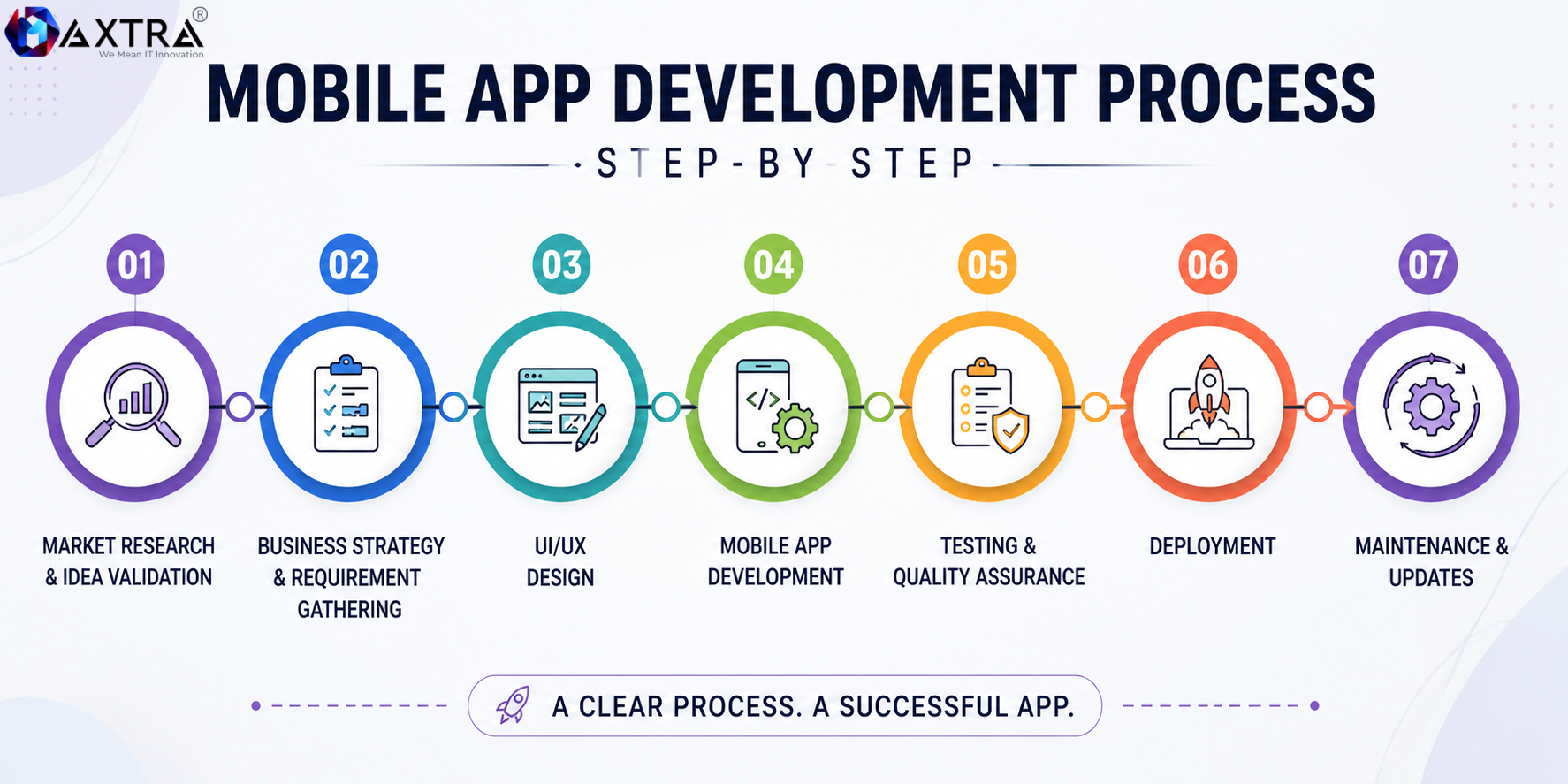
Mobile app development involves following a well-defined framework to minimize risks and optimize business success. To begin with, a structured process helps businesses organize development activities, control resources, and achieve project objectives more efficiently. In addition, following a systematic approach makes it easier to manage each development stage effectively.
Market Research & Idea Validation
Before development begins, companies need to conduct market research on their app ideas. During this stage, activities may include:
- Competitor analysis
- Audience research
- Market demand analysis
- Feature prioritization
In addition, app idea validation helps businesses understand whether an idea is viable in the marketplace. By evaluating user expectations and existing solutions, companies can identify opportunities and refine their concepts before investing heavily in development. As a result, businesses can reduce unnecessary risks and build their applications around genuine market requirements.
Business Strategy & Requirement Gathering
Once the idea is validated, effective app development strategies begin by setting clear objectives. At this stage, important steps include:
- Documentation of requirements
- Mapping user journeys
- Planning of features
- Budgeting
- Risk evaluation
As a result, effective planning ensures that your project does not suffer from scope creep. Furthermore, clearly documented requirements help development teams understand project expectations and maintain consistency throughout the development lifecycle. In addition, proper requirement gathering helps teams identify technical and business requirements before development begins.
UI/UX Design
After the requirements are established, user experience becomes a vital aspect of app success. During the design stage, the process generally includes:
- Wireframing
- User flow planning
- Prototyping
- Interface designing
Moreover, mobile app UI design and app UX design help increase user interaction and retention. By creating intuitive navigation and visually consistent interfaces, businesses can make their applications easier and more enjoyable to use. As a result, users can navigate important features more comfortably and interact with the application more effectively.
Mobile App Development
Following the design phase, the development stage brings approved ideas into reality through application development. At this point, the development process may include:
- Android application development
- iOS application development
- Backend development
- API integration
- Database development
Additionally, custom application development is often preferred by companies because it can address their specific operational and business requirements. For this reason, developers need to select technologies that align with project goals. Therefore, selecting suitable technologies and development practices is essential for creating a scalable application. Furthermore, following a structured development approach can help teams maintain consistency throughout the implementation process.
Testing & Quality Assurance
Once development is completed, testing an app thoroughly helps ensure its reliability, security, and performance. During this stage, app testing involves:
- Functional testing
- Performance testing
- Security testing
- Compatibility testing
In addition, proper mobile app quality assurance helps identify and resolve potential problems before launch. As a result, businesses can deliver a more stable and reliable application to users. Furthermore, testing different aspects of the application helps teams identify issues that may affect usability, performance, or security. Therefore, comprehensive quality assurance should remain an important part of the development lifecycle.
Deployment
After testing is successfully completed, the app is prepared for release. At this stage, deployment activities typically include:
- Store asset preparation
- Submission to Google Play Store
- Release to Apple App Store
- Launch monitoring
Furthermore, an effective app launch depends on careful planning and compliance with relevant store guidelines. For this reason, developers should verify technical, visual, and submission requirements before publishing the application. In addition, launch monitoring helps teams identify unexpected issues after the application becomes available to users. As a result, businesses can respond to early problems more efficiently.
Maintenance & Updates
Even after the app is launched, development continues through regular maintenance and updates. For example, ongoing tasks may include:
- Bug correction
- Security updates
- Adding new features
- Performance improvements
Moreover, regular app maintenance and mobile app support help keep applications secure, functional, and up-to-date. Consequently, businesses can respond to user feedback, resolve technical issues, and improve the overall app experience over time. In addition, continuous monitoring can help identify performance issues before they significantly affect users. Therefore, regular updates are important for maintaining application quality and long-term usability.
Mobile App Development Cost: Complete Breakdown
The mobile application development cost depends on various factors, including application complexity, functionality, technology, development team, and other project requirements. For instance, hiring a mobile application development company in India can be more affordable than hiring a company from the US.
However, actual development costs vary depending on the project’s scope, technology stack, integrations, and required features. Therefore, understanding these factors allows companies to select a development approach that suits their requirements and budget. In addition, businesses should consider maintenance, testing, infrastructure, and future updates when estimating the overall investment.
Cost Based on App Complexity
| Cost CategoryDescriptionEstimated Cost (USD)Estimated Timeline | |||
|---|---|---|---|
| Simple App | Basic features such as login, user profile, contact forms, and simple UI. Suitable for startups and MVPs. | $3,000 – $10,000 | 1–3 Months |
| Medium Complexity App | Includes payment integration, push notifications, APIs, dashboards, and moderate custom functionality. | $10,000 – $30,000 | 3–6 Months |
| Complex App | Real-time chat, geolocation, video streaming, advanced integrations, and custom workflows. | $30,000 – $70,000 | 6–9 Months |
| Enterprise App | Large-scale applications with advanced security, AI, IoT, ERP/CRM integration, and multi-user architecture. | $70,000 – $200,000+ | 9–12+ Months |
Cost Based on Platform
| PlatformDescriptionEstimated Cost (USD) | ||
|---|---|---|
| Android App Development | Native Android applications built using Kotlin or Java. | $5,000 – $80,000+ |
| iOS App Development | Native iPhone and iPad applications built using Swift. | $5,000 – $90,000+ |
| Cross-Platform App Development | Single codebase using Flutter or React Native for Android and iOS. | $8,000 – $70,000+ |
| Hybrid App Development | Web-based applications built with Ionic or Cordova. | $4,000 – $40,000+ |
| Progressive Web App (PWA) | Web applications that provide an app-like experience. | $3,000 – $30,000+ |
Mobile App Development Timeline
The mobile application development timeline varies based on project complexity, features, platform selection, and integrations. Therefore, understanding the development timeline helps businesses plan product launches more effectively. In addition, realistic timeline planning can help development teams allocate resources and organize project milestones.
Generally, simple applications require less development time, while enterprise-level solutions need additional planning, testing, and integration. As the scope increases, development teams may also need more time for quality assurance and deployment. Furthermore, complex applications may require additional development cycles because of advanced features and third-party integrations.
Mobile App Development Timeline by App Type
| App TypeTypical FeaturesEstimated Timeline | ||
|---|---|---|
| Simple App | User registration, profiles, basic dashboard, content management, contact forms | 1–3 Months |
| Medium Complexity App | Payment integration, push notifications, booking systems, API integrations, analytics | 3–6 Months |
| Complex App | Real-time chat, video streaming, GPS tracking, marketplace functionality, advanced reporting | 6–9 Months |
| Enterprise Application | AI-powered features, ERP/CRM integration, IoT connectivity, advanced security, multi-role access | 9–12+ Months |
Choosing the Right Mobile App Development Technology
Choosing the right technology stack is extremely important when creating a secure, scalable, and efficient mobile app. Therefore, businesses should consider their objectives, target users, budget, required performance, and future scalability to make the right decision. In addition, the selected technology should support the application’s long-term requirements.
For example, native technologies may be suitable when platform-specific performance is important. On the other hand, cross-platform frameworks can help businesses develop applications for multiple platforms using a shared codebase. As a result, businesses can select an approach based on their platform requirements and development objectives.
Similarly, backend technologies should be selected according to application requirements, expected traffic, security needs, and integration requirements. For this reason, technology selection should be aligned with both current and future application needs. As a result, the right technology combination can support better performance and long-term scalability.
| TechnologyBest For | |
|---|---|
| Swift | Native iOS app development |
| Kotlin | Native Android app development |
| Java | Enterprise and legacy Android applications |
| Flutter | Cross-platform apps with a single codebase |
| React Native | Cross-platform development using JavaScript |
| .NET MAUI | Businesses using Microsoft technologies |
| Node.js | Real-time and scalable backend development |
| Laravel | Secure APIs and business applications |
| Firebase | MVPs, startups, and rapid app development |
| AWS / Google Cloud / Azure | Scalable cloud hosting, storage, and infrastructure |
Mobile App Development Architecture
Mobile app architecture plays a vital role in forming a good application by facilitating communication among different components of the system. Moreover, a well-structured architecture improves performance, security, scalability, and maintainability. In addition, it helps development teams organize different application components more effectively.
At the same time, it supports future business growth by allowing development teams to modify and expand application components more efficiently. Consequently, businesses can adapt their applications as user requirements and workloads change. Therefore, selecting a suitable architecture is important for building applications that can support long-term requirements.
Mobile App Architecture
Mobile application architecture refers to the structural design framework of an app. In simple terms, it determines how different parts of the application work together to provide a smooth user experience. Furthermore, this structure defines how application components communicate and process information.
Additionally, a suitable architecture helps developers organize application components and establish efficient communication between different system layers. Therefore, selecting an appropriate architecture is important for maintaining application performance and scalability. As a result, development teams can manage application components more efficiently as the project grows.
Client Layer (Presentation Layer)
The client layer represents the user interface of the software application where users interact with the system. In addition, it handles the user interface, user experience, navigation, and device-specific functionalities. For this reason, the client layer plays an important role in how users interact with the application.
As a result, an efficient presentation layer can provide users with a consistent and responsive application experience across supported devices. Furthermore, an intuitive interface can make navigation easier and improve overall usability. Moreover, responsive presentation components can help users access important features more conveniently.
API Layer
The API layer acts as an interface between the mobile application and backend systems. Consequently, it enables secure data transfer, third-party integrations, and communication between frontend and backend components. In addition, APIs allow different systems to exchange information according to defined requirements.
Furthermore, well-designed APIs help applications exchange information efficiently while supporting scalability and integration requirements. For example, APIs can connect mobile applications with payment gateways, mapping services, analytics tools, and other external platforms. As a result, applications can integrate additional services without requiring every function to be built directly into the mobile interface.
Backend Layer
The backend layer manages business logic, authentication, user management, data processing, notifications, and application workflows. In addition, it processes requests from the mobile application and provides the required information efficiently. Therefore, backend functionality is essential for managing application operations behind the user interface.
Moreover, a reliable backend is essential for applications that handle complex business processes, user accounts, transactions, or real-time services. Furthermore, scalable backend architecture can support increasing user activity as the application grows. As a result, businesses can manage higher workloads while maintaining application functionality.
Database Layer
The database layer stores and manages application data, including user information, transactions, content, and analytics. For this reason, a well-designed database helps maintain data consistency, availability, and reliability. In addition, proper data organization can help applications access required information efficiently.
Moreover, proper database management allows applications to retrieve and process information efficiently as the number of users and transactions increases. As a result, businesses can maintain better application performance while managing growing amounts of data. Furthermore, efficient database management supports the application’s ongoing scalability and operational requirements.
Cloud & Infrastructure Layer
The cloud infrastructure layer provides scalability, security, storage, backup, monitoring, and disaster recovery capabilities. For example, platforms such as AWS, Microsoft Azure, and Google Cloud offer scalable infrastructure solutions. In addition, cloud services can support different application workloads according to business requirements.
As businesses grow, cloud-based infrastructure can also help applications handle increasing workloads while supporting reliable data storage and system availability. Furthermore, cloud services can simplify monitoring, backup management, and infrastructure scaling. Therefore, businesses can use cloud infrastructure to support application availability and future growth.
How to Choose the Right Mobile App Development Company
When choosing a mobile app development company, consider several factors to ensure that your project is completed effectively. First, evaluate the company’s technical expertise, previous projects, communication process, and development approach. In addition, reviewing these factors can help businesses understand whether a development partner aligns with their project requirements.
- Industry Expertise Assessment: First, choose a company that has experience developing mobile apps for businesses similar to yours.
- Portfolio and Case Study Analysis: Next, review its previous work to evaluate design quality, functionality, and technical capabilities.
- Communication Approach: Similarly, choose a company that maintains transparent communication and provides regular project updates.
- Pricing Model Analysis: Furthermore, consider fixed-price, dedicated-team, and time-and-material pricing models. In addition, make sure the company clearly explains all costs.
- QA Approach: Moreover, ensure that the development team performs the necessary tests for performance, security, usability, and compatibility.
- Post-Launch Support: Finally, choose a company that provides maintenance, monitoring, and update services after launch.
Ultimately, choosing a reliable app development company can help you create a scalable, secure, and successful mobile application. Therefore, businesses should compare relevant factors carefully before selecting a development partner. In addition, evaluating technical expertise, communication, pricing, QA, and post-launch support can help businesses understand the services they can expect throughout the development lifecycle.