








A right on-demand app development company can turn a traditional service-based enterprise into a digital platform with scalability. Irrespective of whether you wish to develop a food delivery software, home service marketplace, healthcare scheduling application, taxi app, grocery delivery application, or some other kind of a real-time service application, the choice of your technology partner can affect your product’s quality, security, scalability, time-to-market, and costs in the future.
A more practical approach will be assessing the possible developers in terms of their experience, technical skills, understanding of your business model, development process, communication skills, security measures, scalability, and pricing.
This article will help you understand what to look for when selecting a developer for your on-demand platform.
How Do You Choose the Right Development Partner?
Right partner has experience working on similar applications, has a proven portfolio of delivered projects, has proper level of technical competence, uses open development process, implements secure systems, develops scalable architecture, uses efficient communication process, and provides post-launch support.
It is also important to know what kind of service is provided by the partner, to whom the ownership of source code and intellectual property belongs, how any modifications will be done, and what will happen after the deployment of the application.
The aim is not to get the cheapest developers. The task is to find a company able to build a product which will suit your needs now and in the future.
What Is On-Demand App Development?
On-demand app development is the process of developing digital platforms that enable customers to make orders for their required products or services as well as contact organizations or individuals offering these products/services to them.
Unlike a normal business app, an on-demand app usually comprises multiple elements. A typical solution may include:
- Customer mobile app
- Service provider or partner app
- Admin console
- Order management
- Location and tracking
- Online payments integration
- Push notifications
- Ratings and reviews
- Customer support
As an example, a marketplace for home services might let a customer choose the service, schedule time slots, get a professional, make a booking, pay for it, manage the appointment, and leave a review.
What this implies is that your developers need to know about business processes and marketplaces rather than mobile applications only.
Why Choosing the Right Development Company Matters
On-demand platforms usually contain more elements than regular mobile applications. Development groups might have to link mobile apps, APIs, databases, payments, maps, notification, analytics, cloud solutions and administration software.
Incorrectly chosen technical solutions will cost much money to fix in future. Here are some examples:
- Bad architecture will cause problems with scalability in the future.
- Inefficient API will affect performance.
- Insufficient testing will lead to booking/payment problems.
- Bad UX will result in a high abandonment rate.
- Non-maintenance will lead to compatibility problems after updating the operating system.
So, the task is to find developers capable of providing reliable, secure, scalable and commercially reasonable products.
Top 10 Things to Look for Before Hiring an On-Demand App Development Company

1. Look for Relevant Experience
Begin with one of the essential questions first: Has the company developed a product with workflows that resemble yours? Experience is significant since various on-demand platforms have different operational difficulties.
The relevant experience, depending on your industry, can include:
- Restaurant
- Taxis and Transportation
- Grocery Delivery
- Home Services
- Healthcare Booking
- Courier and Logistics
- Multi-Vendor Platforms
It would help if you did not judge a company just by the number of their projects available on their website. Instead, inquire about the difficulties faced and overcome by the company, the technologies they have used, the integrations they have performed, the problems they faced, and the outcome.
An example of a small portfolio that contains highly relevant projects can be better than an extensive portfolio of unrelated applications.
2. Review the Portfolio and Case Studies Carefully
The portfolio needs to be more than just a set of beautiful screenshots. When analyzing their previous works, try to find the information whether the company had been dealing with technical and operational needs of the product.
Take into account:
- What kind of app was created?
- Were dedicated customer and provider apps developed?
- Did the project feature real-time tracking capabilities?
- Did payment gateways integrate?
- Was Android, iOS, or both platforms used?
- Does the company provide post-launch maintenance?
If possible, ask whether you can see the demo of the previous application. This will let you differentiate the company with the experience of delivery from the company that only lists a certain service on its website.
3. Evaluate Technical Expertise
It is recommended that the partner uses the technologies that meet your needs and not apply the same for all the projects. In line with different products, the team may use technologies like:
- Flutter
- React Native
- PHP
- .NET
- PostgreSQL
- MySQL
- MongoDB
- AWS
- Microsoft Azure
- Google Cloud
The key question here should be:
What is the best technology for me according to my needs, budget, performance and roadmap?
Cross-platform development works when you need both Android and iOS apps at the same time by sharing a huge part of the codebase. But in some cases, native development will work better due to different criteria. It would be better if your partner could explain this difference.
4. Make Sure They Understand Your Business Model
Even a robust technical solution can be a flop if the development team does not know how your business works. Before development starts, your development partner needs to be familiar with issues such as:
- Who is your customer base?
- Who is offering the service?
- How is the provider assigned?
- What is the process for making a booking?
- How do you earn money?
- What happens if the provider refuses a request?
- What happens if the customer withdraws?
- How are refunds made?
For instance, the workflow of the taxi booking system will differ from that of the cleaning service marketplace, although both of them have booking functionality. Your development partner must be able to convert all these business rules into a tangible product and technology stack.
5. Understand Exactly What the Development Services Include
Prior to signing the contract, make sure you know what is covered by the scope of the engagement. This may consist of the following items.
Product discovery
- Requirement analysis
- Market and competitor research
- User flow mapping
- Feature prioritization
- Technical consultation
User interface/user experience (UI/UX) design
- Wireframes
- User flows
- Interactive prototypes
- Design system
- Customer application design
- Admin dashboard design
Development
- Android application
- iOS application
- Cross-platform application
- Backend development
- Admin dashboard
Testing
- Functional testing
- Usability testing
- Performance testing
- Security testing
- Device testing
Deployment and support
- App store submission
- Google play deployment
- Cloud deployment
- Monitoring
- Bug fixing
The better this list of deliverables is described, the simpler it will be for you to compare various proposals.
6. Ask for a Transparent Cost Estimate
Among the initial queries for enterprises, we can point out such one as:
How much would it cost to develop an on-demand app?
This question doesn’t have any single response since the final cost will depend on many factors including the functionality of the app, platforms, types of users, integrations, etc. For this reason, it’s crucial for the development company to know your requirements.
What Influences the Development Cost?
Your budget can be influenced by:
- Number of platforms
- Number of features
- Backend architecture
- Real-time tracking
- Payment gateways
- Third-party API connections
- Artificial Intelligence (AI)
- Multi-currency
- Analytics
- Post-launch support
Minimum viable product (MVP) and a big multi-sided marketplace are two very different projects.
Ask for a Feature-Based Estimate
Rather than asking: How much is my app going to cost me?
Ask instead: Can you offer a detailed development cost estimation per feature?
The correct proposal will allow for distinguishing between:
- Discovery
- UI/UX design
- Mobile development
- Backend development
- Admin panel
- API integrations
- Testing
- Deployment
- Maintenance
This makes differences in scope much easier to identify.
7. Make Security Part of the Development Strategy
On-demand platforms have the capability to handle personal information, addresses, location information, payment information, business information, and transaction information.
Therefore, security needs to be taken into consideration when planning and designing the software rather than after completing the software development process. Inquire from prospective development partners about:
- Authentication
- Role-based access
- API security
- Data encryption
- Payment security
- Session management
- Database security
- Dependency management
- Monitoring and logging
There may be varying security and compliance requirements based on the industries and geographical regions that you target.
A responsible development partner will know about the requirements during the discovery phase rather than making blanket compliance statements without knowing anything about your project.
8. Evaluate Scalability and Performance
Your platform may start with serving a few customers and suppliers but will eventually grow into a bigger platform. Thus, it is important that the architecture provides a realistic way of growing the platform.
Consider such questions as:
- How will increased load affect the backend?
- How will the system deal with peak loads?
- What Is the Role of Databases?
- How will APIs be managed?
- How will real-time geolocation work?
Scalability does not mean developing a most complex architecture right away. It is usually better to develop an architecture fitting the stage and providing room for growth in the future.
9. Understand the Development Process
A development team must have a well-defined process. Here’s how a usual project process goes:
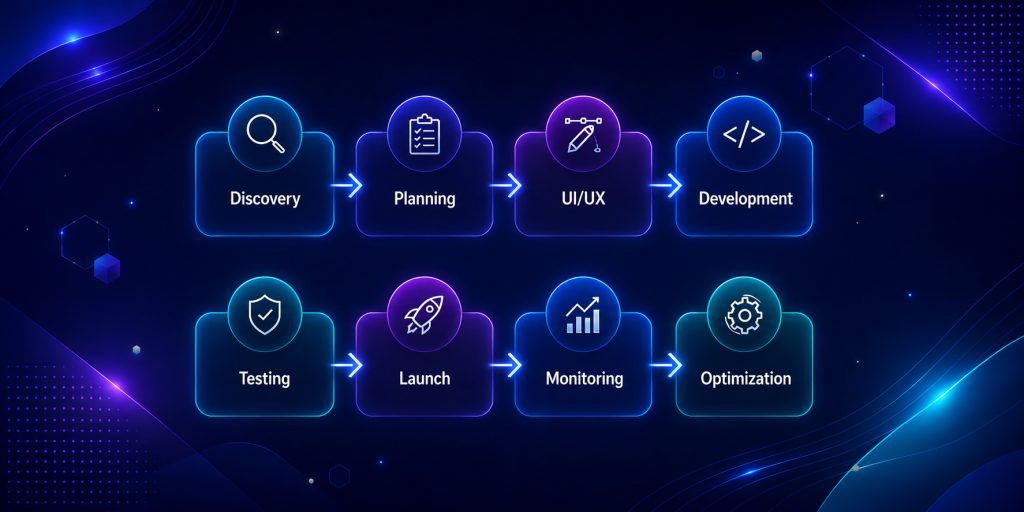
But before you sign on the dotted line, make sure to figure out the following points:
- Who will be the manager of the project?
- How will the requirement be documented?
- How is the change of scope managed?
- What Is the Frequency of New Build Releases?
- How will you give feedback?
Clear communication and documented processes can prevent many problems during development.
10. Check Post-Launch Support
The deployment of the app does not mean that the process ends there. Following deployment, you might require:
- Bug fixing
- Updates to maintain OS compatibility
- Security updates
- Server monitoring
- Optimization
- Analytics
- Database management
Find out if these services are covered in the original agreement or offered for an additional fee. Other things to consider are:
- Duration of support
- Time of response
- Maintenance costs
- Emergency support
- Costs of feature enhancement
- Infrastructure management
An experienced development company must have a well-defined support system in place rather than an undefined one after deployment.
Questions to Ask Before Hiring a Development Partner
These questions should be posed to the companies shortlisted for the contract:
- Have you developed a product like mine before?
- Can you show me some related case studies or demonstrations?
- What technology stack do you suggest and why?
- What does the cost quote cover?
- How would your back end be scaled if the number of users grows?
The answers may provide more information about the company than the company materials themselves.
Don’t Forget Source Code and Intellectual Property Ownership
This is one critical area that businesses often fail to consider while selecting a vendor. Prior to signing the contract, it is essential to ensure clarity on who will have ownership of access to:
- Source code
- User interface/user experience design
- Database
- Documentation for API
- Cloud services
- Code repository
- Hosting account
- Accounts for third-party services
- Technical documentation
It is best if ownership/access to these resources is explicitly specified in the contract.
Custom Development vs. White-Label Solutions
One more dilemma faced by companies is whether to opt for a tailor-made solution or white label software.
Custom Software
Tailor-made product usually offers better control over:
- UX/UI
- Logic of business processes
- Integration options
- Scalability
- Data architecture
- Features roadmap
- Branding
The price to pay would be higher upfront cost and development time.
White Label Software
White label platform may offer:
- Faster implementation
- Reduced initial development needs
- Built-in features
- Standardized workflows
- But customization options will be limited.
It all depends on your business goals, budget, approach to differentiation, and further growth plans.
How Much Does It Cost to Build an On-Demand App in India?
There can be a wide range of costs associated with creating an on-demand platform in India.
An MVP that offers a single service would differ greatly from a multi-purpose marketplace with real-time tracking and a variety of features, including complex backend processes, multiple payment gateways, advanced analytics, and enterprise-level infrastructure.
Do not depend on any standard cost range; rather, make a scope document for:
- Business Model
- Target Audience
- Platforms
- User Roles
- Key Features
- Integrations
This way, developers can estimate the cost better.
Main Cost Drivers
| Factor | Potential impact |
| Number of platforms | More platforms can increase development effort |
| User roles | Multiple applications increase complexity |
| Real-time features | Tracking and live updates require additional infrastructure |
| Backend complexity | Complex workflows increase development effort |
| Integrations | Payment, maps, communication, and third-party APIs add work |
| UI/UX | Advanced experiences require additional design and development |
| Security | Sensitive data may require additional controls and testing |
| Scalability | Larger expected traffic can require more robust infrastructure |
| Maintenance | Ongoing updates add to the long-term budget |
The most useful estimate is therefore one based on your actual scope rather than a generic industry figure.
Why Maxtra Technologies Can Be Considered
When considering evaluation of companies for an on-demand project, then Maxtra Technologies may be evaluated based on the same factors that have been mentioned in this guide. Prior to starting any project, one should discuss his/her business model, target audience, required platforms, workflow, integrations, scale, timeline and budget with the development team.
A good discovery process should lead to a clear understanding of:
- Product requirements
- Scope of MVP
- User roles
- Technology stack
- UI/UX requirements
- Backend architecture
- Integration requirements
- Testing strategy
- Deployment strategy
- Technical support
The aim should be making a practical technology roadmap instead of just receiving a development quotation.
When talking about a new service marketplace or real-time platform, the correct partner will assist in turning a basic idea into the structured product strategy, developing UX, apps and backend, integrating necessary services, testing, launching and technical support afterwards.
Conclusion
Choosing an on-demand app development company is no less a business decision than a technical one. The ideal partner will know everything there is to know about your business model, customer, process, technical issues, budget and future prospects. It will provide you with a practical plan instead of guaranteeing the lowest price or fastest delivery.
While selecting a vendor, think about some factors, including experience in this field, technical expertise, quality of portfolio, communication, security, scalability, pricing transparency, ownership of source code, development approach and post-release support.
Of course, most of all, look at what the vendors can offer you in terms of value and capability, and not just at the quotation they give. If you keep in mind all these factors, you will be able to make a sound choice and develop an on-demand platform that will be ready not only to operate but to develop further.
Frequently Asked Questions
What is an on-demand app development company?
On-demand app development company is one which provides its services for developing applications that help customers reach goods, services, professionals, businesses and other suppliers based on immediate or scheduled demands. It may include client and supplier applications, admin panel, back-end system, payment solutions, push notifications, and location-based solutions.
How to choose the best development company?
It is important to analyze experience, portfolio, technical competences, business model understanding, development process, security solutions, scalability, price transparency, communication process, source code ownership and post-development support of companies.
How much does the development cost?
This depends on the characteristics of the product, platforms, roles of the users, integration with third-party services, UI/UX design, back-end solutions, real-time solutions, security solutions, scalability and other factors. The detailed estimate of the development process should be provided by developers.
How much time is required for creating my on-demand app?
Development of a minimum viable product will take several months, but creation of a comprehensive marketplace on several platforms may take much longer. It totally depends on project size, quantity of apps, integrations, etc.
What features do I need to incorporate into my on-demand application?
It will always have registration, profiles, search for services, booking, provider matching, payment system, notifications, geo-location, real-time tracking, rating & review, order management and administration panel.
Planning an On-Demand App?
It is recommended to define your potential audience, the business model, core functions, chosen platforms and objectives for MVP before turning to software development agencies. This way, it will be easier for you to get reliable estimates and compare different options.
Contact Maxtra Technologies to discuss your on-demand app specifications and a realistic development path.