







Digital marketing is essential for businesses that want to succeed in today’s competitive landscape. However, having a strong online presence requires more than social media and paid advertising. A well-planned technical SEO checklist can help businesses identify website issues that may affect search visibility, crawling, indexing, and user experience.
Businesses can use strategies such as search engine optimization (SEO), social media marketing, and pay-per-click advertising to reach their target audience. As a result, these strategies can improve brand visibility, website traffic, conversions, and revenue.
Whether you are a small startup or an established enterprise, digital marketing can support long-term growth. Therefore, partnering with a trusted digital marketing agency can help your brand build a stronger presence online.
However, a visually appealing website may not rank well in search results without a technically sound foundation. This is where technical SEO becomes important.
What Is Technical SEO?
So, what is technical SEO?
Technical SEO includes practices that help search engines crawl, understand, index, and access a website efficiently. In addition, it can improve website usability and support better search visibility.
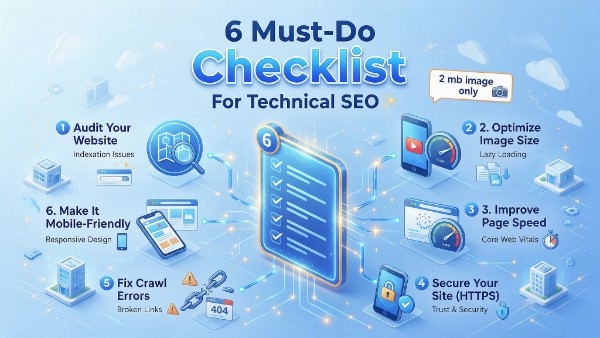
Therefore, this technical SEO checklist covers important areas that you should review regularly. These areas include crawlability, indexing, crawl budget, internal links, sitemaps, and mobile usability.
1. Improve Website Crawlability
You must ensure that essential resources on your website are accessible to search engine crawlers. For example, important JavaScript, CSS, and other resources should not be unnecessarily blocked.
Similarly, your robots.txt file can control which parts of your website search engines can crawl. However, incorrect rules may prevent important pages or resources from being crawled.
Therefore, use an SEO crawler to identify blocked pages and review whether those restrictions are necessary.
SEO Tools for Crawlability
Several SEO tools can help you analyze website crawlability. For instance, Screaming Frog and Website Auditor can identify technical issues and help you review important website resources.
2. Check Website Indexing
Crawlability should be followed by an indexing review. In other words, you need to check whether search engines are actually indexing the pages that should appear in search results.
The number of indexed pages should generally make sense compared with the number of important pages on your website. However, the numbers do not always need to match exactly because some pages may not be suitable for indexing.
Therefore, review your noindex directives, canonical tags, robots.txt rules, and other indexing settings. This process can help you identify pages that may be unintentionally excluded from search results.
3. Optimising Crawl Budget
Setting and monitoring your crawl budget is important for effective SEO, especially for large websites. Crawl budget refers to the number of URLs that search engine crawlers can process during a given period.
Therefore, understanding crawl activity can help you identify potential technical issues. Google Search Console can provide useful information about your website’s crawl activity.
However, if you need a detailed page-by-page analysis of server activity, log file analysis tools such as WebLog Expert can also be considered.
In addition, efficient internal linking and a clean website structure can help search engines discover important pages more effectively.
4. Audit Internal Links
Internal linking is an effective way to connect related pages and distribute internal authority across a website. However, internal links should also be logical and useful for visitors.
Therefore, include an internal linking audit in your technical SEO checklist. Check important factors such as click depth, broken links, redirected links, and orphan pages.
Furthermore, review whether your important pages receive enough relevant internal links. A clear internal linking structure can make website navigation easier for both users and search engines.
5. Review and Optimise Your Sitemap
An XML sitemap helps search engines understand the important URLs available on your website. In addition, it can support the discovery of new or updated content.
If you want to improve your technical SEO, reviewing your sitemap is an important step.
Furthermore, keep your sitemap clean and updated. Avoid adding unnecessary pages, broken URLs, redirected URLs, or pages that should not be indexed.
The size of your sitemap is also important. Google supports up to 50,000 URLs in a single sitemap file. If your website contains more URLs, you can use multiple sitemap files and a sitemap index.
As a result, maintaining a clean sitemap can make it easier for search engines to identify the URLs you want them to discover.
6. Make Your Website Mobile-Friendly
Google uses mobile-first indexing. This means that Google primarily uses the mobile version of a website’s content for indexing and ranking.
As a result, your mobile website should provide the same important content and structured information available on the desktop version.
Therefore, creating a mobile-friendly website is an essential part of technical SEO. Additionally, check page speed, navigation, readability, responsive design, and mobile usability.
A smooth mobile experience can help visitors access your content more easily. At the same time, it supports a better overall website experience.
Why Technical SEO Matters
Technical SEO creates a strong foundation for search visibility. Without it, search engines may have difficulty crawling, understanding, or indexing important website pages.
Therefore, businesses should regularly review technical SEO factors and address issues that could affect website performance. A structured technical SEO checklist can make this process easier and more consistent.
Conclusion
In conclusion, technical SEO is an important part of maintaining a search-friendly website. Crawlability, indexing, crawl budget, internal links, sitemaps, and mobile usability all deserve regular attention.
By following this technical SEO checklist, businesses can identify technical issues and create a stronger foundation for search engine visibility and user experience.
For professional guidance, you can consider Maxtra Technologies for technical SEO and digital marketing services.