







In response to increased customer expectations for convenience, personalized services, secure payment options and quick order delivery. The retail industry is evolving as companies that previously relied only on physical stores start using digital channels to interact with customers, operate and enhance customer experience.
Retail App Development Company allows a company to address these expectations by developing an application that connects customers, product offerings, payments and operations of a business. Contemporary retail applications use innovations such as artificial intelligence (AI), cloud computing, inventory management in real-time and omnichannel commerce to make everyday retail activities easier.
In 2026, retail mobile applications are not limited to online shopping platforms anymore. They are tools for retailers to analyze customer needs, streamline operations and engage with their audience.
This blog will review how retail app development is revolutionizing contemporary business, the technology driving the industry, key features of applications and what companies should take into account before creating a retail mobile application.
What Is a Retail App Development Company?
A retail app development company designs, builds and maintains mobile apps that help retail firms handle shopping, customer engagement, payments, product catalogs and inventory processes.
They collaborate with the business to identify their needs and create applications that cater to different kinds of retail models depending on whether they run online shops, supermarkets, fashion outlets, grocers or multistore retailers.
Some of the common retail app development services are:
- Shopping applications for customers
- Product catalog and order management applications
- Inventory management applications
- Loyalty and rewards application for retail
- Payment integration
- Omnichannel shopping applications
- Analytics and reporting
The end goal is to provide an integrated digital experience that would serve both customers and retail businesses.
Why Are Businesses Investing in Retail Mobile Applications in 2026?
Customer expectations have grown beyond merely buying products from retailers. Customers expect easy access to products, transparent delivery of products, personal offers, and payment methods. With the help of mobile apps, retailers can offer all the above-mentioned experience through a platform they can customize according to their requirements.
There are some prominent reasons why businesses are opting for retail mobile application development, which include:
1. Enhanced customer engagement: Mobile apps facilitate communication through personal offers, notifications of purchases made, and loyalty programs.
2. Shopping convenience: Through mobile apps, customers can buy products without visiting the store.
3. Customer retention: It is possible due to personalized product recommendations and rewards.
4. Efficiency of operations: Through mobile apps, retailers can integrate inventory management, purchases, payment methods and other customer information.
5. Insights into business: With the help of analytics on apps, retailers can learn about the behavior of customers.
For businesses that wish to enhance their digital presence, mobile apps will play an important role in their future growth.
How Are Mobile Apps in the Retail Industry Transforming Different Business Sectors?
Several industries are affected by retail technology because of transaction simplification, product availability, and customer business connection.
1. E-commerce and Traditional Retail Industry
The applications of retail allow online retailers and traditional businesses to make customers’ lives easier. This includes browsing product lines, checking availability, comparing prices, reading reviews and making purchases on a smartphone.
Through developing a custom mobile app, one can implement the features corresponding to business needs and customer wishes. For instance, a fashion retailer may offer customized product recommendations, whereas a multi-location business will show customers product availability in different locations.
2. Grocery and Supermarket Industry
Grocery businesses operate with regular orders, changes in product lines, and timely deliveries. Mobile apps allow simplifying these processes with the opportunity for customers to order the desired goods and choose between convenient delivery or pick-up options.
Grocery shopping app development can have the following characteristics:
- Product availability in real-time
- Shopping list
- Scheduled delivery
- Payment options
- Order tracking
- Discounts and coupons
3. Fashion and Lifestyle Businesses
Mobile applications could be used by fashion retailers to exhibit their collections, offer personalized shopping experience, and enhance customer engagement. Functions like virtual try-on, sizing advice, visualization of products and wish list management could assist customers in making informed purchases.
Also, shopping habits and buying history can be taken into account when recommending certain products and seasonal collections.
4. Manufacturing and Distribution
Another type of business where retail related applications will be helpful is manufacturing, wholesaling, and distributing companies. These companies could benefit from using the digital platform to manage their product catalogues, wholesale orders, distributors’ communications, and delivery status updates.
Retail software development could become integrated solutions connecting inventory management, sales, and distribution processes together.
5. Food and Beverage Businesses
Cafés, restaurants, and food chains utilize mobile applications to facilitate ordering and customer interactions. They can browse through menus, order custom meals, pay for the orders and get delivery updates. In addition, some apps include repeated order features, loyalty programs, and location-based marketing.
What Are the Essential Features of a Modern Retail Mobile Application?
The success of any retail application lies in its ability to fulfill the real needs of businesses and customers through its features.
These are some important features and benefits that businesses should keep in mind while building a retail app.
1. Easy Registration and User-Friendly Navigation
It is important for businesses to focus on user-friendly navigation and good UI/UX.
2. Integration of Secure Payment Gateway
A good payment gateway enables customers to make their payments using different modes of payment. It can depend upon the target audience whether businesses want to integrate credit cards, debit cards, UPI, digital wallets or net banking for payment purposes.
3. AI-Based Recommendation of Products
AI-based recommendation helps in analyzing the related activity and recommendations of the customers’ choice of product. For instance, if there is an online fashion store, it can recommend the products to the customers based on their purchasing history or activity.
4. Real-Time Inventory Management
Inventory tracking is necessary for retailers dealing with a variety of products or several shops/warehouses. The creation of retail inventory management apps can contribute to the management of stocks, availability of goods, ordering goods and synchronizing inventory.
5. Order Tracking and Notifications
Customers expect complete information about the order. Order tracking and notifications provide information regarding order confirmation, shipment dispatch, delivery and other important updates.
6. Loyalty Programs and Rewards Programs
Retailers can motivate customers to buy again through reward points, memberships, referral schemes and promotions.
How Is AI Changing Retail Mobile Applications?
Artificial intelligence is assisting retailers in creating a more personalized experience for digital shoppers.
The use of artificial intelligence in retail mobile applications can aid several business operations.
- Personalized product recommendations: AI algorithms can utilize customer interaction data to recommend products based on personal preferences.
- Shopping assistants through conversation: AI assistants can help customers search for products, product information, and assist in shopping.
- Visual search: Customers can conduct a search for similar products through images instead of searching only through texts.
- Demand prediction: Predictive analysis can assist retailers in understanding how much of a product will be demanded.
- Customer service through automation: AI assistants can answer queries related to order status, delivery status, return policies, and product availability.
Businesses need to adopt AI technology according to their requirements and keep certain aspects into consideration while implementing it.
What Is the Retail App Development Process?
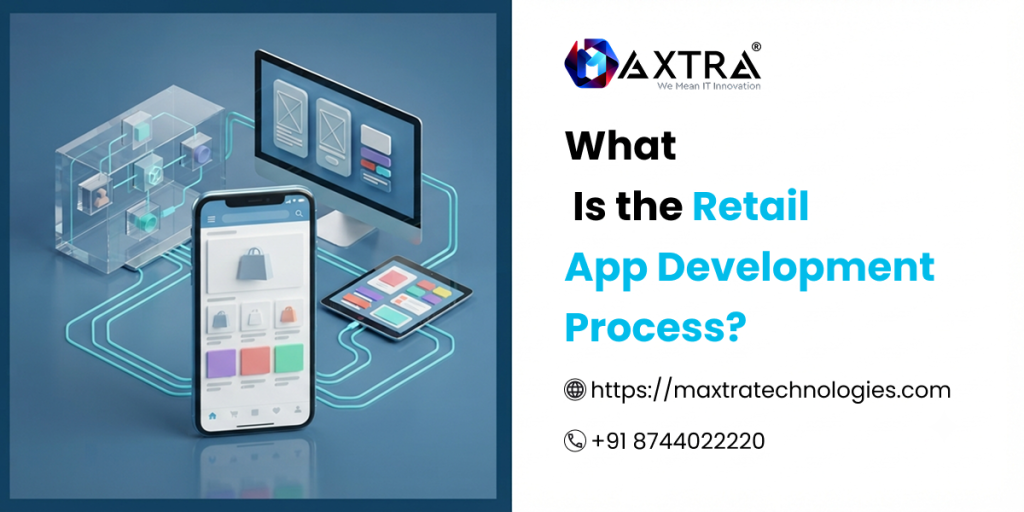
The creation of an application goes through several stages: from determining business needs to implementation and further support.
Step 1: Requirement Analysis
The development team determines the business model, the audience of the business, its objectives, key features, and technical requirements.
Step 2: Research and Planning
Through market research and competitor analysis, a business gets acquainted with customer expectations and learns how to make its application stand out from others.
Step 3: UI/UX Design
The design team creates application layout, its navigation system, and interactive prototypes that will ensure convenience of the user experience.
Step 4: Application Development
Developers code frontend, backend, databases, APIs, and all necessary third-party integrations.
Step 5: Testing and Quality Assurance
The testing team makes sure that the application performs according to all specified requirements.
Step 6: Deployment
Having obtained necessary approvals, the application is deployed on the relevant distribution platforms.
Step 7: Maintenance and Improvements
Maintenance after the launch includes bug fixes, updates, performance analysis, and development of new features. Such an approach allows businesses to handle development requirements and plan further improvements.
How Much Does Retail App Development Cost?
The development of mobile retail applications will incur cost according to the complexity of the application, design considerations, chosen platform, integrations, and additional functionality. The most basic retail application can be composed of registration, product catalogues, shopping carts and payment functionality.
A more sophisticated application may have recommendations driven by AI, multi-vendor support, inventory sync, loyalty program, and other enterprise-level integrations. It is recommended for businesses to establish their minimum required features prior to asking for the quote.
One possible way is to start from MVP development to launch the application with core functionality, gather user feedback and develop further according to user needs.
How to Choose the Right Retail App Development Company?
Partner selection is crucial in the process since the quality of an application may affect user experience, performance, and scalability.
The following issues should be considered before choosing a company:
- Experience in the industry: The review of previous projects related to retail and e-commerce applications.
- Technical proficiency: Understanding of its experience in the areas of Android, iOS, APIs, backend solutions, and cloud technologies.
- Integration: Experience in integrating payment gateways, inventory systems, CRM, and ERP software.
- Issues related to security: Understanding of authentication, encryption, protection and application testing procedures.
- Project transparency: Understanding of timelines, milestones, communication and delivery expectations.
- Support and Maintenance: Support and maintenance after the launch: Understanding of maintenance and upgrade services.
Conclusion
With evolving trends in retail, it is important to focus on the connection between customers and products via technological advancements and personalization. One can use a professional Retail App Development Company in order to implement the required technologies and create apps, which would match their business needs.
There are multiple practical possibilities in regards to retail apps, including everything from AI recommendation, real-time inventory tracking and payments to omnichannel commerce solutions. The main thing is to focus on solving actual issues with the help of modern technologies rather than following the current trends.
With appropriate planning, the right partner in development and continuous optimization, it is possible to develop retail applications, which will drive sustainable digital growth in 2026. For those who are planning to implement their next digital strategy, it may be useful to look into the right retail business mobile app solutions.
Frequently Asked Questions
1. What is retail app development?
Retail app development refers to designing, creating, testing and maintaining retail business mobile applications.
2. Why are retail mobile apps beneficial?
Retail mobile apps are beneficial because they provide convenient shopping opportunities, personalization options, communication with customers, better management of orders and inventory, and chances to build customer loyalty.
3. How much time does it take to develop retail mobile apps?
Development time varies depending on the specific features of the application, its complexity, integration needs and testing process.
4. Is it worth developing a custom retail mobile app for a small business?
Yes. It is possible to create a mobile app which will be based on the basic requirements of a business and will not require large investments.
5. How is AI used to improve retail apps?
AI can be implemented in order to personalize products, allow visual searching, use conversational shopping assistants, forecast demand and automate customer service.