








Mobile Apps: Over the past ten years, our relationship with mobile apps has completely shifted. Mobile apps are no longer simply digital conveniences for shopping, chatting, or requesting rides; they have become interfaces that bridge our most personal and sensitive data.
Apps today store everything from protected medical histories and secure transactions to user identities that present a risk when compromised, a fundamental fact for apps that handle sensitive data.
In this dynamic, a privacy-first architecture is no longer a value-added proposition or a marketing ploy; it has become the non-starter for any trust-building or long-term innovation and success.
Why Privacy-First Architecture Matters More Than Ever
Rising Cybersecurity Threats
The stakes for digital security have never been higher. Moreover, cyberattacks are becoming more sophisticated and frequent, targeting both businesses and consumers. As a result, organizations need stronger security measures to protect sensitive information and digital assets.
Regulatory Compliance and User Awareness
At the same time, global regulations such as the General Data Protection Regulation (GDPR) in Europe and the Health Insurance Portability and Accountability Act (HIPAA) in the United States are enforcing stricter data-handling practices. In addition, businesses must follow other region-specific compliance frameworks based on their industry and location.
Furthermore, users are now more aware of how their personal data is collected, stored, and used. Therefore, businesses must focus on transparency and responsible data practices to build lasting customer confidence.
Consequences of Data Breaches
A single data breach can cause serious financial and reputational damage. More importantly, it can weaken the customer trust that businesses have worked hard to build. Consequently, companies must treat data security as an essential part of their digital strategy rather than an optional feature.
Embedding Privacy from the Start
Privacy-first design ensures that data protection strategies are not added after development. Instead, security and privacy considerations are incorporated from the earliest stages of the development process.
Moreover, this approach allows development teams to anticipate potential threats and address security risks proactively. As a result, businesses can improve compliance while creating safer digital experiences for users.
Ultimately, privacy-first development is about protecting sensitive data, meeting regulatory requirements, and maintaining user confidence. For this reason, privacy should remain a core consideration throughout the entire app development lifecycle.
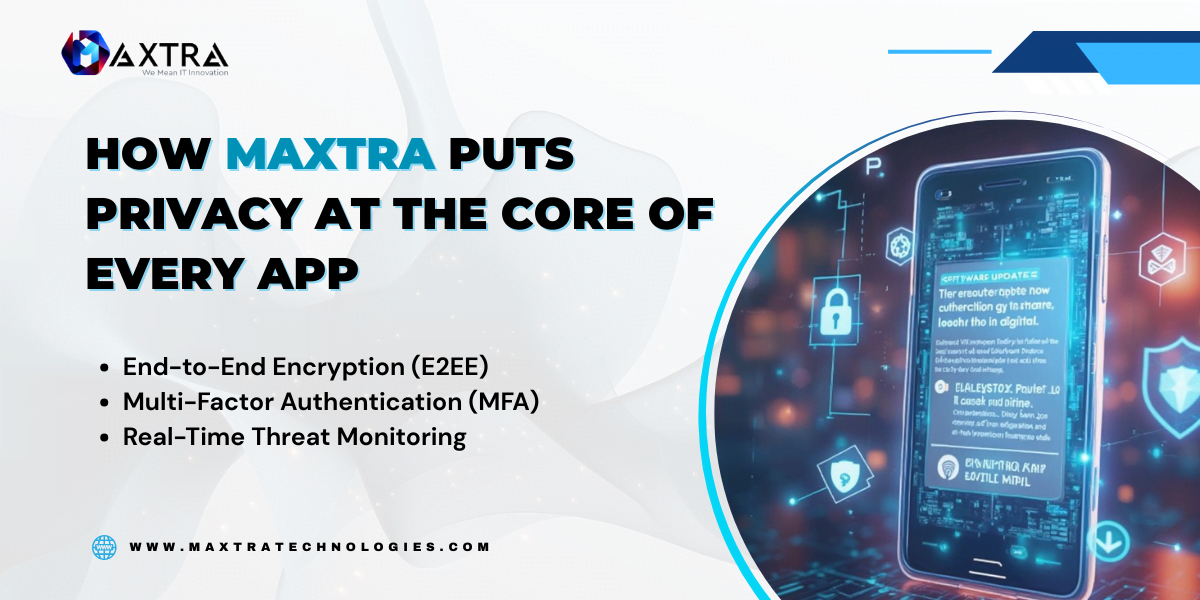
How Maxtra Puts Privacy at the Core of Every App
At Maxtra, privacy and security can be integrated into every stage of app development. From the initial planning phase to deployment and ongoing maintenance, development teams can consider data protection, secure architecture, access controls, and compliance requirements.
Furthermore, a privacy-focused approach helps businesses create applications that are not only functional but also reliable and trustworthy. As a result, organizations can provide users with secure digital experiences while supporting long-term business growth.
At Maxtra, privacy and security are not afterthoughts; they are part of the DNA of every mobile application we build. Our development philosophy treats data protection as a design principle, ensuring every feature, function, and workflow adheres to the highest security standards.
From concept to deployment, our apps integrate:
- End-to-End Encryption (E2EE): Ensures that only the intended recipient can read sensitive data, protecting communications from interception at any stage.
- Multi-Factor Authentication (MFA): It adds an extra barrier, helping to significantly reduce the risk of unauthorized account access even if someone compromises login credentials.
- Real-Time Threat Monitoring: Detects, reports, and neutralizes potential breaches before they escalate, enabling rapid incident response.
Compliance at Maxtra goes beyond ticking boxes. Every mobile solution is built to meet or exceed standards like GDPR, HIPAA, and PCI DSS from the moment of inception.
This means our clients don’t need an expensive and time-consuming security retrofit; their apps are ready for the most demanding industries right out of the box.
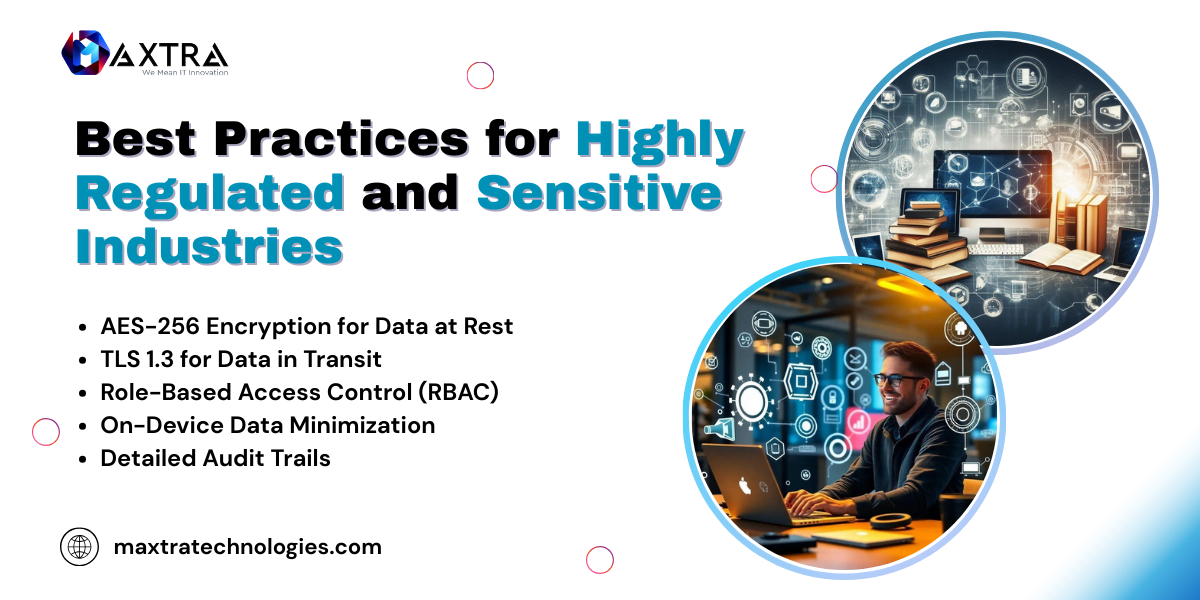
Best Practices for Highly Regulated and Sensitive Industries
In industries such as healthcare, finance, logistics, and government services, data privacy is not just a legal requirement; it’s a matter of operational integrity and public trust.
Maxtra implements a range of advanced measures to ensure every app we create is as secure as it is functional:
- AES-256 Encryption for Data at Rest: Protects sensitive files stored on devices or servers, meeting the gold standard in encryption.
- TLS 1.3 for Data in Transit: Ensures all data transfers between devices, servers, and cloud environments are secure and shielded from interception.
- Role-Based Access Control (RBAC): Restricts data access strictly to authorized individuals based on role and responsibility, minimizing the risk of insider threats.
- On-Device Data Minimization: Limits the storage of unnecessary personal information, reducing exposure in the event of a breach.
- Detailed Audit Trails: Logs every interaction and data transaction to support compliance, accountability, and post-incident analysis.
These measures aren’t optional add-ons; we embed them into the very structure of our mobile applications, ensuring privacy stays uncompromised as apps scale or introduce new features.
Trust as a Competitive Advantage
Security as a Differentiator
In today’s app ecosystem, users judge brands not just by features but by how safely and ethically they handle personal information.
When developers build security into every component of the architecture, apps do more than function – they earn user trust.
Privacy-First Philosophy
Maxtra’s privacy-first design philosophy offers clients more than just robust security; it delivers a competitive edge in a marketplace where digital trust sets winners apart from the rest.
Benefits of Secure-by-Design Principles
By investing in secure-by-design principles, businesses not only shield themselves from regulatory fines and reputational damage but also foster stronger and longer-lasting relationships with their customers.
The Future of Mobile Security
– Advancements in Mobile Security
As mobile technology continues to evolve with advancements like AI-driven fraud detection, biometric authentication, and edge computing, the focus on privacy will only intensify.
– Building Security Into Core Applications
Organizations that build data security into the core of their apps position themselves to adapt quickly to new threats and regulations.
– Maxtra’s Role in Mobile Security Innovation
Maxtra remains at the forefront of this evolution, driving innovation in application security while ensuring each solution embodies transparency, resilience, and user-first ethics.
– Ensuring Trust in a Digital World
in a digital world where trust is hard-earned and easily lost, Maxtra ensures its mobile applications stay as safe as they are sophisticated.