







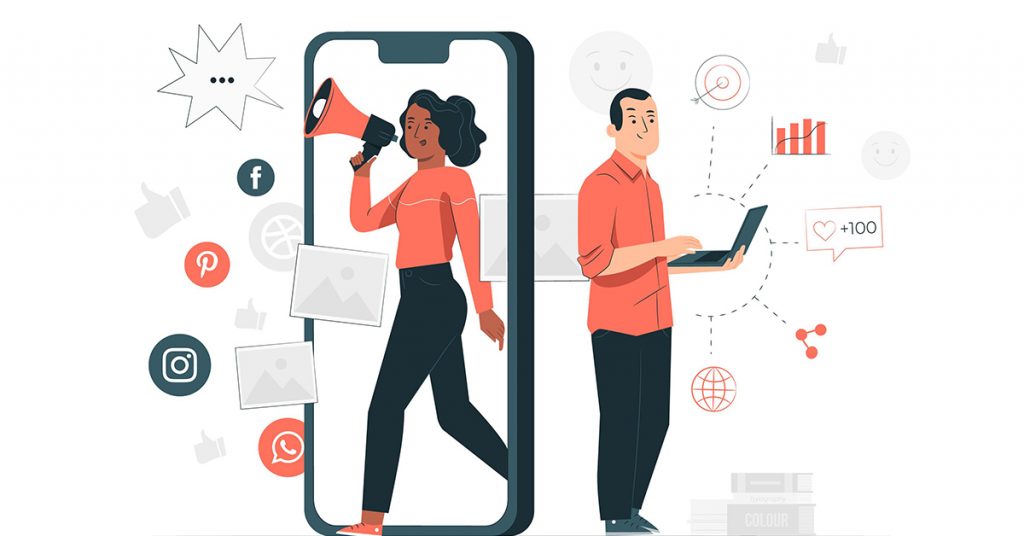
Whilst smartphones and computers are evolving at a precise stage, the role of technology in social media evolution Meanwhile continues with mobile applications.
Alone in 2019, the Lyfemarketing study estimated Furthermore the use of social networks by mobile devices for 91% of all consumers.
Up to this point, we agree that you need to build a social media application.
The list does not, however, conclude with just one aspect of the effect of technology on social media.
Much other technology such as APIs, geotagging, QR codes, etc. helps render where it is now.
By combining automation, social media integration, and e-commerce, technology makes social Similarly networking more accessible, stable, and real-time. These innovations are driving the next phase of growth for social media development
Technologies Driving the future of Social Media

The technologies used in social media are among the main reasons for its rapid growth.
They have changed how people create, share, and consume content.
For example, smartphones now include advanced cameras, GPS, geotagging, and AI-based image recognition. These features are changing the global social media landscape.
Moreover, new technologies are making social platforms more interactive. They also help businesses connect with users in real time.
1. Augmented Reality in Social Media
Role of AR and Mixed Reality
Augmented reality (AR) and mixed reality are becoming important parts of social media.
Many companies now use AR features in their applications.
For instance, facial filters have become one of the most popular uses of AR. They allow users to create fun and interactive content.
Snapchat helped popularize AR-driven filters. Today, brands and individuals use these features to create engaging social media content.
Furthermore, AR gives businesses new ways to connect with their audiences. Users can interact with products, filters, and digital experiences through their smartphones.
AR in Media Advertising
AR is also becoming useful in media advertising.
For example, Snapchat has developed AR features that allow brands to create interactive campaigns.
These campaigns connect digital content with real-world experiences. As a result, users can interact with advertisements in a more engaging way.
However, businesses must also consider privacy and data security when they use AR technology.
On the other hand, companies should maintain a balance between automation and authentic communication.
Therefore, AR can help businesses create engaging social media campaigns when they use it properly.
2. Artificial Intelligence
AI as a Core Technology
Artificial Intelligence is one of the key technologies shaping the media industry.
AI helps media platforms understand user behavior. It can also analyze large amounts of data and identify user preferences.
A digital marketing service provider that offers social media optimization services can help businesses use AI to improve their media strategies.
AI-Driven Personalization and Optimization
AI plays an important role in modern digital marketing. Social media platforms use AI to deliver more relevant content to users.
For example, AI can study user activity and recommend content based on their interests. As a result, users can discover posts, videos, products, and advertisements that match their needs.
Moreover, AI can help businesses improve content performance. It can also help marketers understand audience behavior.
Therefore, artificial intelligence will continue to play an important role in the future of social media.
3. Blockchain
Rise of Decentralized
Blockchain is another promising technology for the media industry. It can support decentralized platforms and give users more control over their digital information.
As a result, businesses can explore new ways to manage data, content, and digital transactions.
Blockchain can also help create more transparent systems. A digital marketing service provider that offers social media optimization services can explore blockchain-based solutions for social platforms.
Fair Monetization and Content Ownership
Many social media networks depend on advertising-based business models. However, content creators may have limited control over how businesses use and monetize their content.
Blockchain can provide new ways to manage content ownership. Smart contracts can also automate digital payments.
For example, creators can use smart contracts to receive payments based on predefined conditions.
In addition, decentralized systems can give users more control over their content. This approach may also reduce dependence on a single central platform.
4. Internet of Things
IoT in Tracking and Marketing
The Internet of Things (IoT) is another important technology in the development of social media.
IoT connects physical devices and allows them to collect and exchange data. As a result, businesses can use real-time information for marketing and customer engagement.
Some major companies use connected technologies for tracking and marketing purposes.
Real-Time Insights Through IoT Integration
Businesses are increasingly looking for software development companies that can create IoT-based solutions.
For example, IoT tools can collect real-time data and provide useful insights. These insights can help businesses make better decisions.
Furthermore, IoT can support social media campaigns by connecting physical experiences with digital platforms.
A digital marketing service provider that offers optimization services can help businesses explore IoT opportunities for social networks.
5. RFID Technology
Understanding RFID
RFID stands for Radio Frequency Identification. It uses small tags or chips to store and transmit information about an object or person.
Each RFID tag can contain a unique identification number. RFID readers can then collect information from the tag when it comes within range.
For example, businesses can use RFID technology to track products, event attendees, or other physical items.
A digital marketing service provider can help businesses explore ways to connect RFID technology with digital marketing and social media campaigns.
Real-World Use Cases of RFID Integration
Suppose you are attending a music festival that uses RFID technology. You may receive an RFID-enabled wristband or device.
With this technology, attendees can interact with event services more easily. For example, they may use RFID for entry, payments, or access to digital content.
Moreover, RFID and NFC technologies are becoming more common in events and e-commerce.
As these technologies grow, social media companies can explore new ways to connect RFID features with mobile applications.
This approach can create smoother digital experiences for users. It can also help businesses collect useful information and improve customer engagement.
Conclusion
Technology continues to change the way people use social media.
Augmented reality, artificial intelligence, blockchain, IoT, and RFID all contribute to this evolution.
Furthermore, these technologies create new opportunities for businesses and users.
As a result, social media is becoming more interactive, personalized, and connected.
Therefore, businesses that adopt the right technologies can create better digital experiences.
They can also build stronger relationships with their audiences.