







The world of mobile technology does not stop growing, according to the Google Consumer Barometer Hybrid we have gone from 44% of mobile use in 2012 to 87% of 2017. India is one of the countries with the highest penetration of mobile technology.
The smartphone has gone from being a tool of communication to being a technological extension of ourselves. From the mobile or tablet, we can update the news, we connect to our bank, we share and we think in RRSS, we are in contact with our friends, we look for work or even monitor our health through various mobile apps.
Importance of Mobile Technology for Businesses Hybrid vs Native Mobile Applications
Following the pace of society, mobile technology has also become an obligation for business: business mobility. From this point of view, the objectives and utilities of mobile apps are very varied:
Key Objectives of Mobile Apps
- Loyalty to customers or employees
- Improve the user experience
- Facilitate effective communication
- Optimize processes
- Gain agility in the critical points of your back office
- Increase productivity
- Increase competitiveness
- Hybrid Mobile Applications
As a company specializing in a digital transformation in Profile today, we know that one of the strategic stakes more important in most organizations is to include in their business processes and operations the mobile application development.
Any company that wants to create a mobile application will find itself at the crossroads of knowing what technology to use for the development and maintenance of the app. This decision will mark the final quality of the application, the development cost, both in time and money, and maintenance costs.
Within the possibilities for the development of mobile applications, we distinguish between two systems: native applications and hybrid applications.
But what exactly are these systems?
Native applications
Native applications are so called because they are developed in the native language of the device itself.
Development Requirements
Depending on the platform in which we want to use our application (Android or iOS) we will have to use a programming language and a specific development environment and know in a certain way the native characteristics of the target operating system.
This makes the creation of multiplatform development teams a complex one, given that, due to the great differences between Android and iOS, we will need a specific profile for each of the platforms. It will also be necessary to coordinate the development simultaneously so that the application has the same appearance and functionality in each of the operating systems.
| OS | Maker | Programming language | Environment |
| Android | Java | Android Studio | |
| iOS | Manzana | Objective C, Swift | XCode |
Benefits of Native Apps
-
Optimal performance due to development directly on the native layer
-
Direct access to mobile device features such as camera or GPS
Disadvantages of Native Apps
-
High development and maintenance cost
-
Requires a specialized team and more development time
-
Code cannot be reused for another platform
Hybrid applications
Hybrid applications use an abstraction layer on the native platform that allows us to encapsulate an HTML5 application in a native application.
Development Benefits
- Develop a single source code for multiple platforms
- Significantly reduces development and maintenance resources
- Reduces time-to-market and cost savings of 30%-50% compared to native apps
- When to Choose Hybrid Applications
Technological Base
The hybrid technology is based on the following technological base: HTML5, JavaScript and CSS. As practically all native mobile systems have a web browser, based as a general rule on a Webkit, we can use this technological base in a safe and standard way.
Functionality Advantages
Hybrid systems wrap the app using the platform’s WebKit, allowing easy publication on Google Play and the App Store. They also connect with native APIs, enabling features like push notifications, camera, GPS, sensors, and in-app purchases.
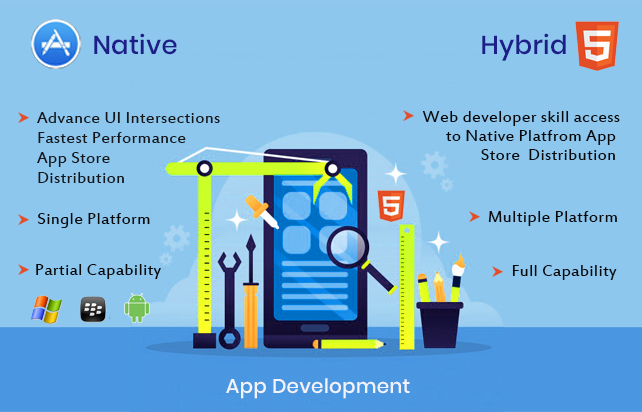
This image is a good summary of the differences between technologies. As it is clearly shown that the hybrid system is way more advantageous as compared to native, combining the virtues of web development with access to all the native functionalities.
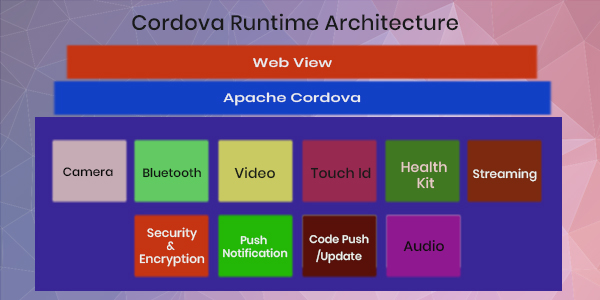
If we go into more detail in the different hybrid technologies that exist, currently highlights the open source framework of Apache Cordova. Large companies such as Adobe, Intel or Microsoft guarantee this technology by helping its development with products oriented to this framework such as PhoneGap, XDK or its integration in Visual Studio through the TACO tools.
In the following image, we can see how the architecture of this platform works and how Cordova bridges us between the WebKit part and the native part of the system.
Layers Architecture of Execution Cordova
Hybrid technology also has its weak points. Regarding native apps, performance is lower when running on a WebKit layer and its unnatural aspect, which can interfere with the user experience.
To counteract the disadvantages of hybrid applications, new techniques and strategies are being defined:
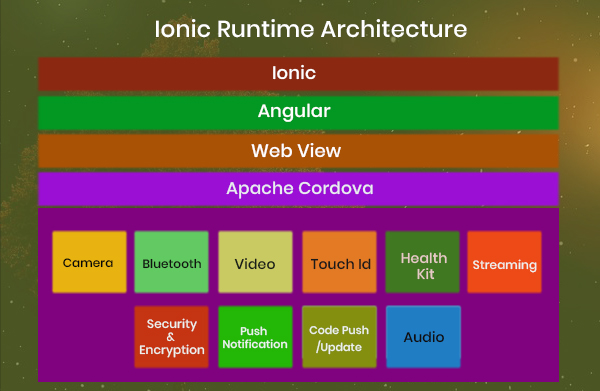
Improve UX of the application by applying visual frameworks aimed at mobile devices such as Ionic.
Architecture Mobile Ionic App
Performance Optimization
Furthermore, performance optimization plays an important role in mobile app development. Developers can use lightweight protocols such as REST APIs and JSON to improve communication between the app and server.
In addition, high-availability systems can help maintain reliable backend performance. As a result, users can experience faster and more stable application performance.
Conclusion
In conclusion, the right development approach depends on the application’s requirements. For example, if an application requires high performance, native development can be a suitable option.
Moreover, native development is often preferred for games, virtual reality, and augmented reality applications. These applications usually require strong device performance and smooth user interactions.
On the other hand, hybrid development can be suitable for management apps and data-processing applications. Similarly, it can work well for online stores, CRM systems, and back-office applications.
Furthermore, hybrid development can reduce development costs and shorten development time. It can also simplify maintenance because developers can use a shared codebase.
Therefore, businesses should consider performance, budget, development time, and maintenance requirements before selecting the right development approach.